
The Factory That Changed Everything
How xAI built the fastest large-scale AI deployment in history — and what it means for every shuttered industrial building in America

They didn’t build Colossus.
They found it.
In December 2023, a holding company called Phoenix LLC purchased a former Electrolux appliance manufacturing plant at 3231 Paul Lowry Road in Memphis’s Boxtown neighborhood. 785,000 square feet of heavy industrial space. $35 million. No press release.
The building had been empty since 2020. It had floor loads rated for server rack density, existing industrial electrical infrastructure, and proximity to the Memphis Sands Aquifer. The bones were right. xAI later built an $80 million greywater recycling plant on site — but the water infrastructure was already there.
By the time the world learned about Colossus in June 2024, xAI had been building for six months.
The Timeline That Matters
From acquisition to TVA Phase 1 approval: eleven months.
December 2023 — Phoenix LLC purchases 3231 Paul Lowry Road for $35 million. No announcement.
June 5, 2024 — Public announcement. Memphis Chamber press release. The market learns what the signals already showed.
July 9, 2024 — MLGW council vote. Existing 8MW service upgraded to 50MW, committed to 150MW. Service agreement executed.
August 2024 — Phase 1 substation complete. Built by xAI, not MLGW. Construction time: 97 days. Cost: $24 million. 35 gas turbines on site for backup and supplemental power.
November 7, 2024 — TVA Board votes to approve 150MW grid service. Phase 1 done.
February 12, 2026 — TVA Board approves Phase 2, 150MW additional. Total approved grid capacity: 300MW. Second substation: another 97 days, another $24 million.
Total elapsed: 26 months from acquisition to 300MW TVA-approved.
Compare that to Microsoft Fairwater in Wisconsin — announced March 2023, operational early 2026. Approximately three years from announcement to operation, greenfield, on a former Foxconn site with existing infrastructure advantages.
xAI did it in less than half the time. The difference is the building they started with.
The Real Constraint
Memphis has cheap power. TVA rates are among the lowest in the country.
That’s the story that gets written.
It’s the wrong story.
Here is the actual state of the Memphis interconnection queue as of today.
Grid-approved data center capacity in the entire Greater Memphis MSA: 300 megawatts. That is the Paul Lowry Road campus, both phases, TVA board-approved.
Total announced pipeline: 955 megawatts conservative, 2,479 megawatts high case.
That gap — 2,179 megawatts of announced capacity with no approved grid path — is the real Memphis infrastructure story.
The bottleneck is not TVA generation. TVA generates plenty of power. The bottleneck is two things: the MLGW distribution infrastructure required to deliver power to a specific parcel, and the TVA board, which must vote on any new load exceeding 100 megawatts. The board vote alone takes months. The substation construction — if you’re waiting for MLGW to build it — takes 12 to 18 months from capital budget commitment.
To understand how concrete this constraint is: Colossus 2, currently under construction at 5420 Tulane Road, has no utility power contract with MLGW. As of August 2025, MLGW confirmed only 0.5MW of general services at the site — enough for a small office. The world’s largest AI deployment under active construction is running on turbines across a state line. That is what 2,179 megawatts with no approved grid path actually looks like on the ground.
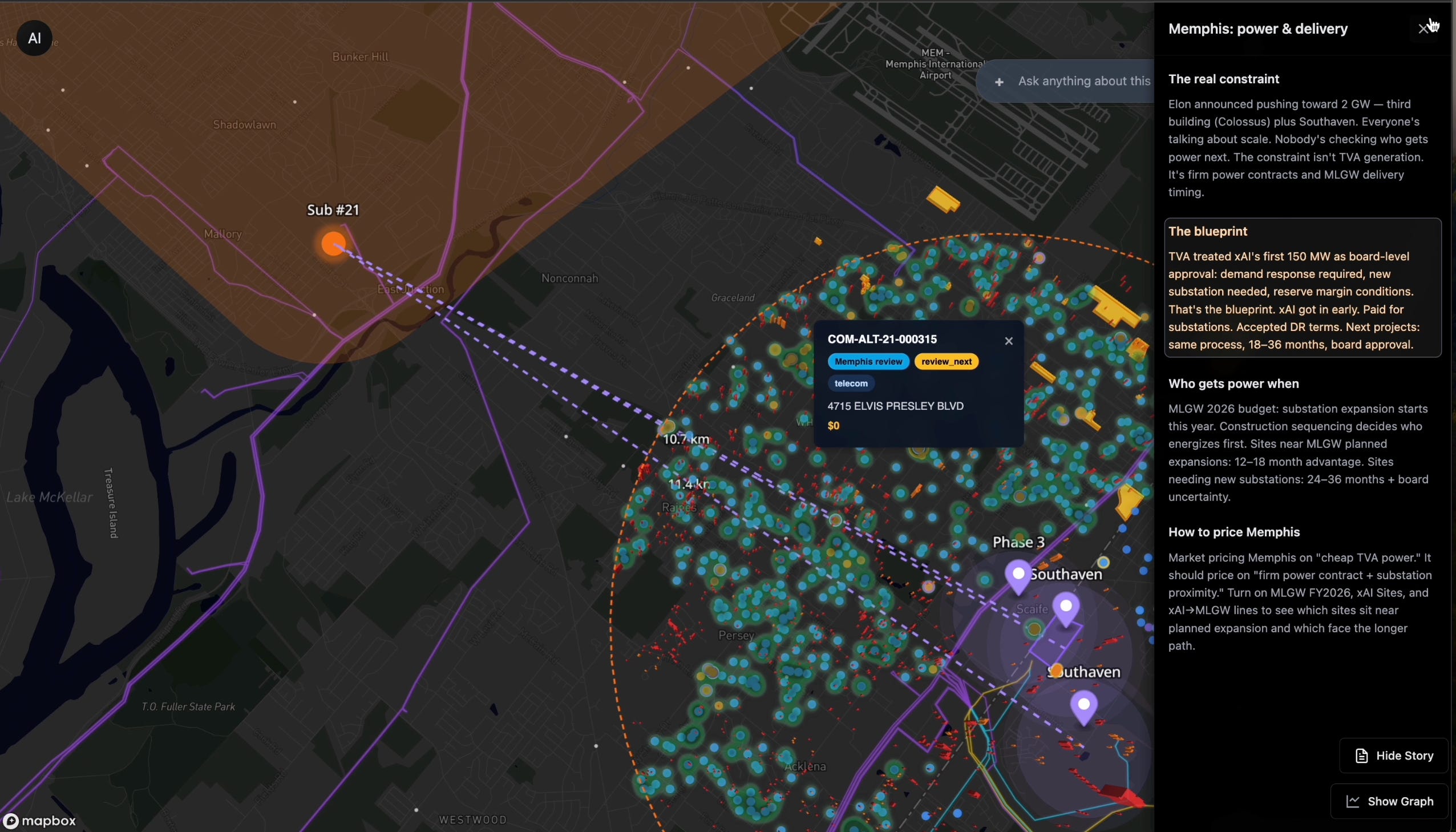
For FY2026, MLGW has 24 active projects across 7 substations in their capital plan. The most significant capacity additions are in the southwest corridor near Substation 83 — the same geography where Colossus 1 was built — and Substation 21 on East Mallory Avenue, nearest to the Southaven-area sites. Sites within delivery range of these FY2026 expansions have a 12 to 18 month path to energization. Sites requiring a new substation outside the current plan are looking at 24 to 36 months minimum, plus a TVA board vote.
The 12-18 month window isn’t an advantage over the 24-36 month window. It’s an advantage over not being in the queue at all.
How xAI Built a Parallel System
Here’s the part the delivery timing story doesn’t capture.
xAI didn’t just find a way around the constraint. They built a parallel power system that makes the MLGW/TVA queue largely irrelevant to their own operations.
The signal appeared before anyone was looking. In May 2025, a SEC filing revealed Stateline Power LLC — a joint venture between Solaris Energy Infrastructure and xAI, 50.1% Solaris, 49.9% xAI — with a $555 million equipment loan covering both 2979 Stateline Road in Southaven and 5420 Tulane Road in Memphis. This filing appeared months before the property purchase at Stateline Road was publicly known. The parallel power system was already being financed while the property hadn’t yet changed hands.
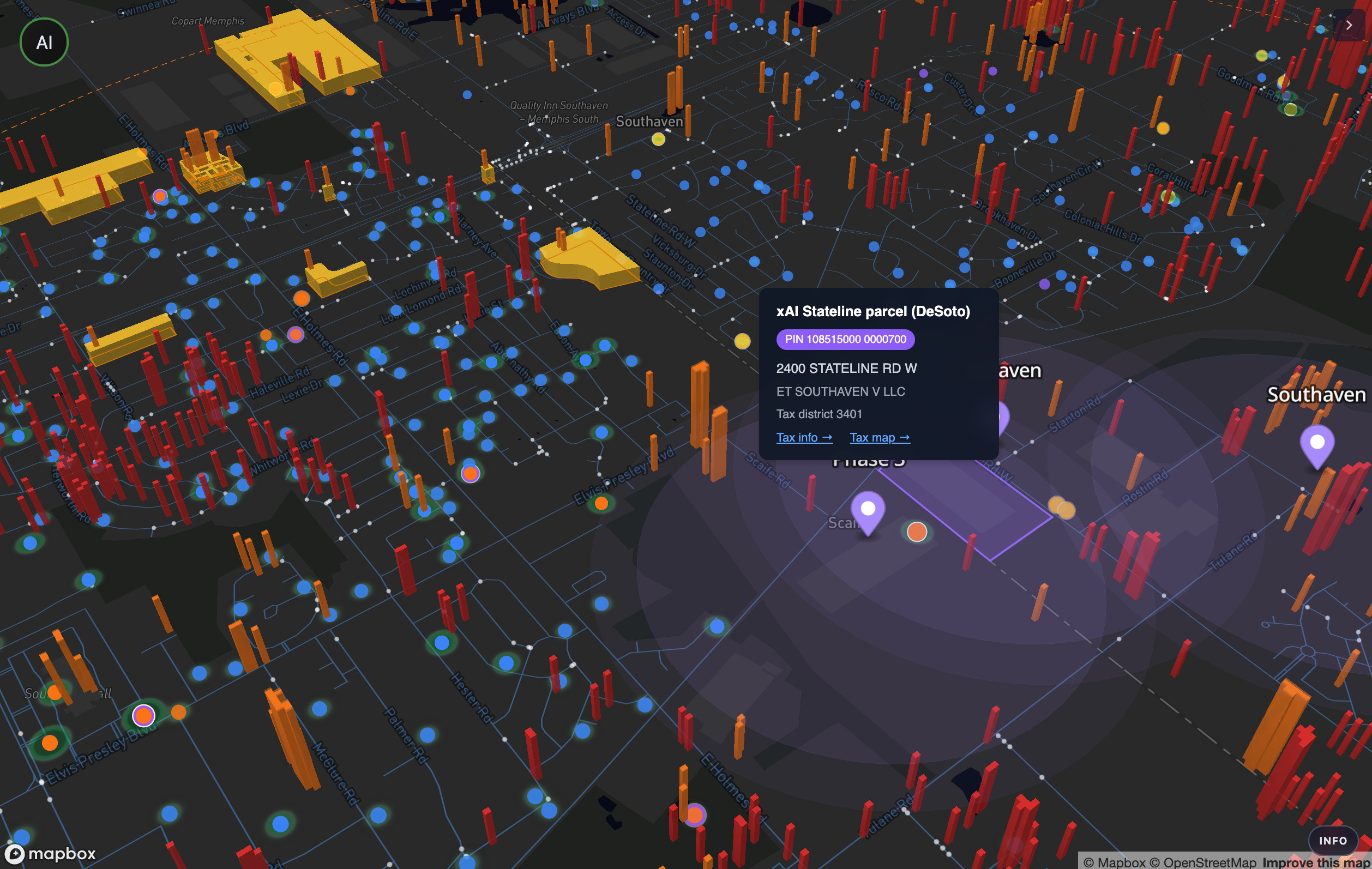
In July 2025, MZX Tech LLC purchased 114 acres at 2875 Stanton Road in Southaven — a former Duke Energy site — for $10. Then in December 2025, the same entity acquired 810,000 square feet at 2400 Stateline Road — a warehouse sitting directly on the Tennessee-Mississippi border, functionally adjacent to Colossus 1. Neither parcel appears in the EnerGov building permit system. What shows up instead: an MDEQ permit application for 41 permanent natural gas turbines representing 1.2 gigawatts of permitted permanent generation capacity, approved unanimously by the MDEQ Permit Board on March 10, 2026. Plus 27 temporary turbines already operating on site outside the permit.
xAI isn’t waiting in the utility queue. They built their own power grid.
This is the same playbook as Colossus 1, scaled up by an order of magnitude. At Paul Lowry Road, xAI built their own substation — twice, at $24 million each — to compress MLGW’s 12-18 month construction timeline to 97 days. At Southaven, they bypassed the utility relationship entirely. The constraint applies to every developer in this market except the one who defined it.
What the Permits Showed First
The Gridwatch dataset — pre-queue signal intelligence built by my research partner Ankur Podder from public land records, LLC filings, permit databases, and utility filings — first detected the xAI Colossus project on December 1, 2023. The public announcement was June 5, 2024.
That is a 187-day lead.
The signals were in public records for six months before the press release. Not because someone had inside information. Because someone was reading the right documents in the right order. A Wyoming LLC formation filed at 1450 Page Mill Road, Palo Alto — the same address as CTC Property LLC.
A utility transmission easement filed with DeSoto County six days before a $10 land purchase. A SEC filing revealing a $555 million equipment loan for addresses that hadn't yet changed hands publicly.
Each signal alone is noise. In sequence, it's a construction timeline that the market won't see for months. The average lead time across completed Memphis MSA projects in the dataset is 93.5 days. Colossus was detected twice as early as the average.
The Stateline Power LLC SEC filing in May 2025 is a live example of the same methodology — a $555 million financing structure visible in public filings months before the property purchase or public announcement.
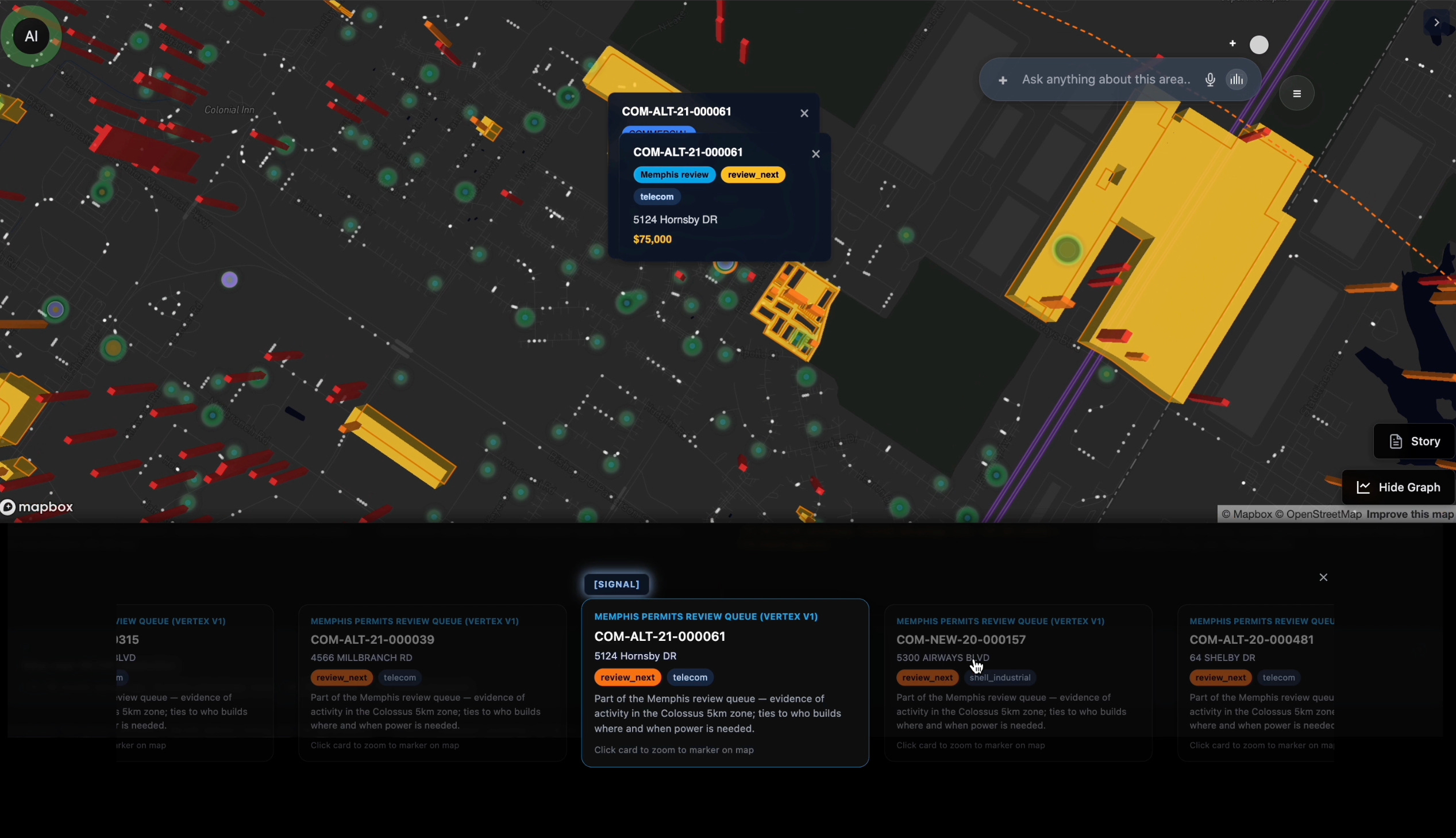
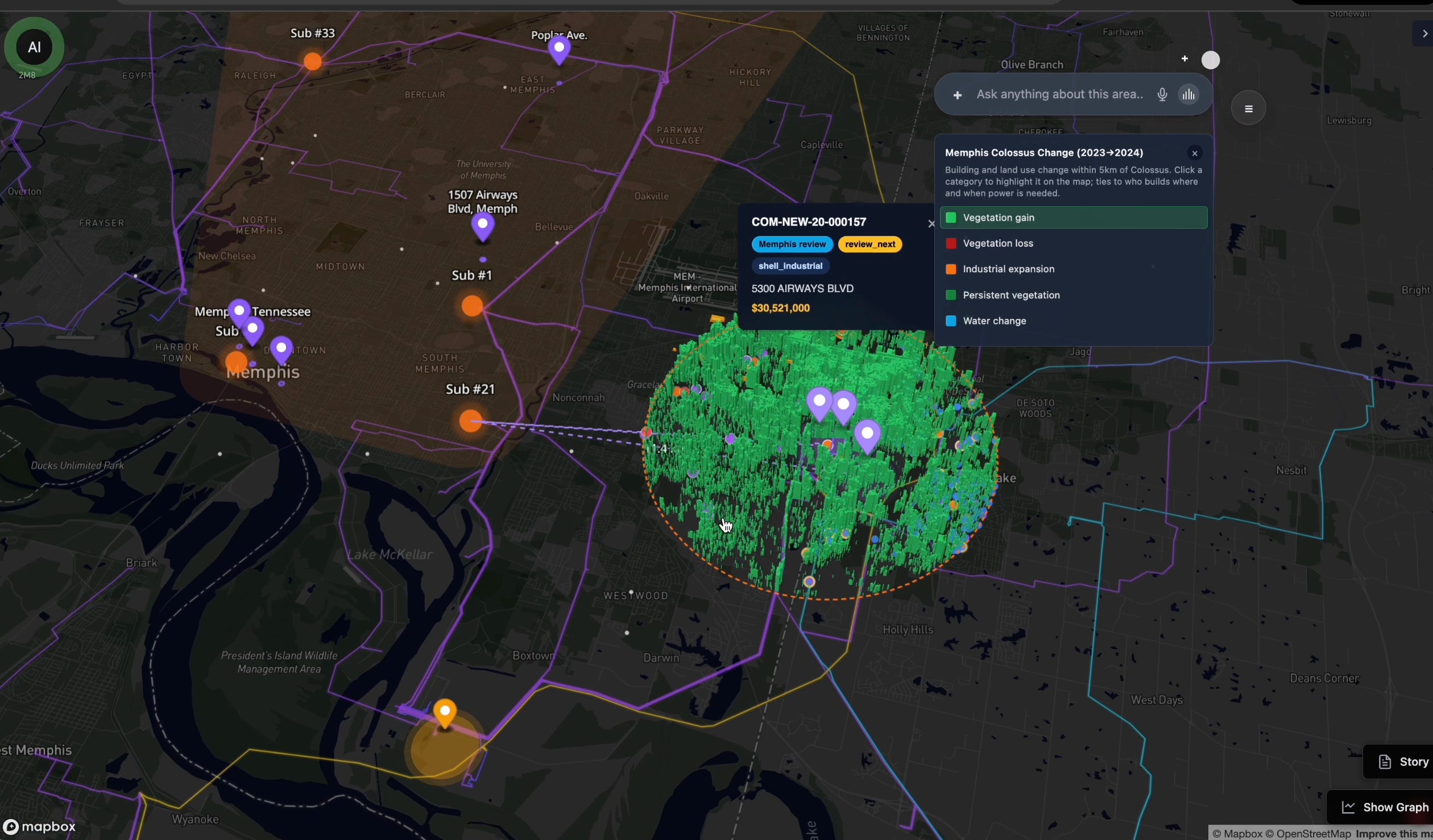
Within a 5-kilometer radius of Colossus, the Memphis permit database contains 198 recent permits, 111 of which were flagged by AI classification for further review. Three signals stand out.
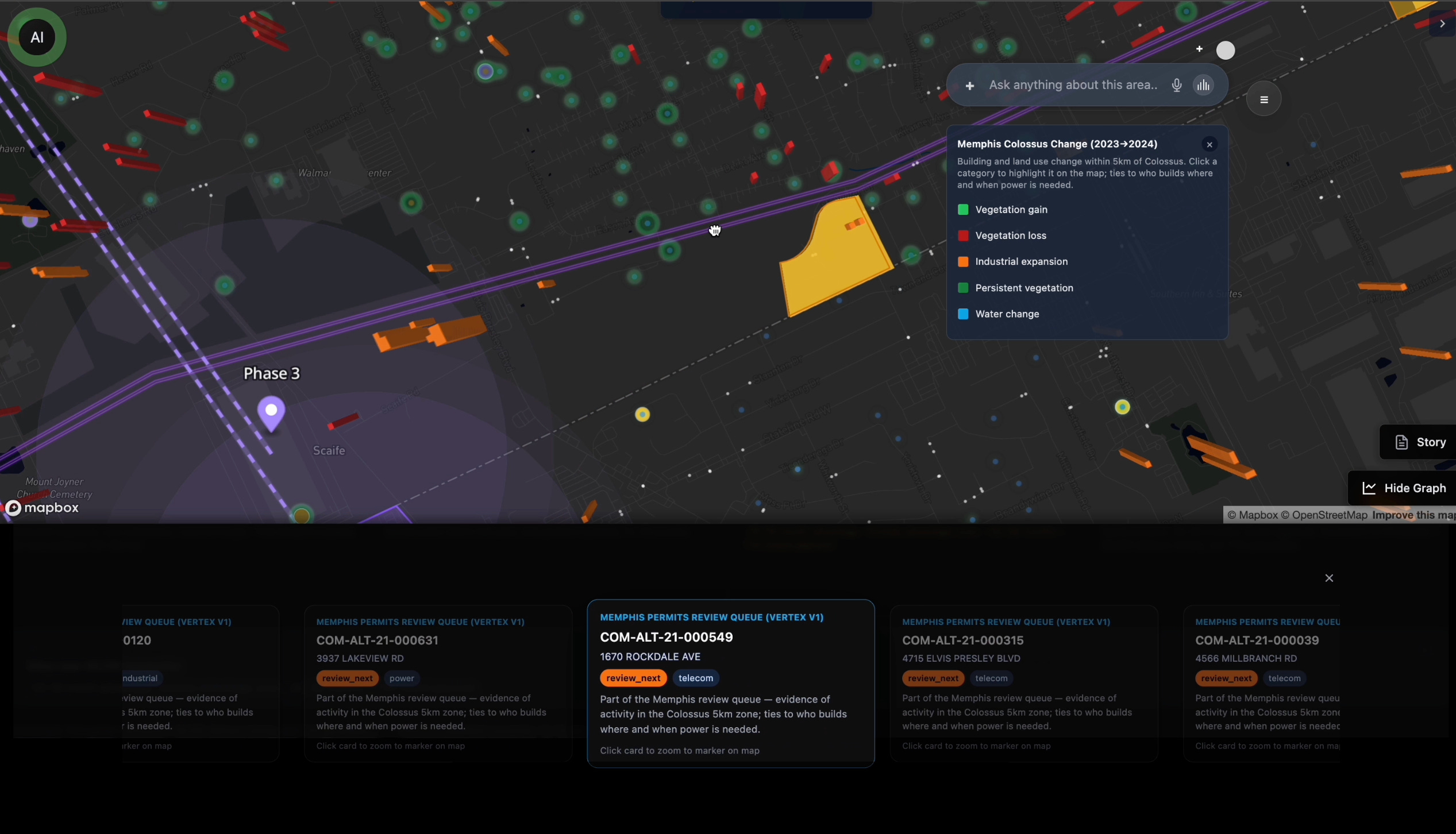
Two electrical room permits at 5420 Tulane Road — the Colossus 2 campus — each valued at $958,183, describing “Exterior Electrical Room, Building 2” and “Exterior Electrical Room, Building 3.” These were filed before the $659 million expansion permit that made headlines. The electrical rooms were the signal. The headline came later.
A permit at 4719 Horn Lake Road describing a “Fiber Hut — Memphis 2 Project.” An unmanned communications shelter valued at $130,000. Telecom infrastructure precedes compute infrastructure. This is what pre-arrival looks like.
And the satellite data: 12.29 hectares of new industrial expansion — 30.4 acres of changed land cover between 2023 and 2024 — that matches no residential or commercial permit filing. Pad preparation. Not buildings yet.
The permits are filed. The signals are there. Most people aren’t reading them.
What This Means
One more thing the pipeline numbers don’t capture.
The MDEQ public hearing for MACROHARDRR drew unanimous opposition. Over 900 signatures. NAACP. SELC. Earthjustice. Residents reporting noise, respiratory issues, formaldehyde exposure. The permit passed on March 10. But every future developer in this cluster now faces a harder permitting environment than xAI did.
Environmental permitting is becoming a constraint alongside grid delivery — and unlike substation timing, it doesn’t have a predictable clock.
That is a risk signal. It belongs in any serious analysis of this market.
The Tri-State Picture
Memphis is not a city. It’s a cluster.
Six projects. Three states. Two grid operators. Two completely different power strategies.
xAI Colossus 1 at Paul Lowry Road — 300MW TVA-approved, confirmed. The only grid-approved capacity in the MSA.
xAI Colossus 2 at Tulane Road — 1.1GW grid request pending TVA capacity study, no approval timeline. Currently running on Southaven turbines with 0.5MW from MLGW.
xAI MACROHARDRR in Southaven, Mississippi — 1.2GW permitted permanent generation via MDEQ, plus 27 temporary turbines operating. Bypasses the TVA queue entirely.
Google’s West Memphis campus in Crittenden County, Arkansas — $4 billion Phase 1, 1,178 acres, 600MW solar filed with the Arkansas Public Service Commission. On Entergy’s grid, not TVA’s. A separate supply chain entirely.
AVAIO Digital Leo in Pulaski County, Arkansas — $6 billion first phase, 150MW contracted with Entergy Arkansas, scaling toward 1GW. Also Entergy, not TVA.
The TVA constraint story applies to Tennessee and Mississippi. Arkansas is on Entergy. Two different grid stories, often written as one.
The headline number across the cluster: 300MW approved. 955MW to 2,479MW in the pipeline. 2,179MW with no approved grid path.
What I’m Building
A live Mid-South infrastructure map. Same methodology as Switchyard — the Texas map from last week. Deeper data.
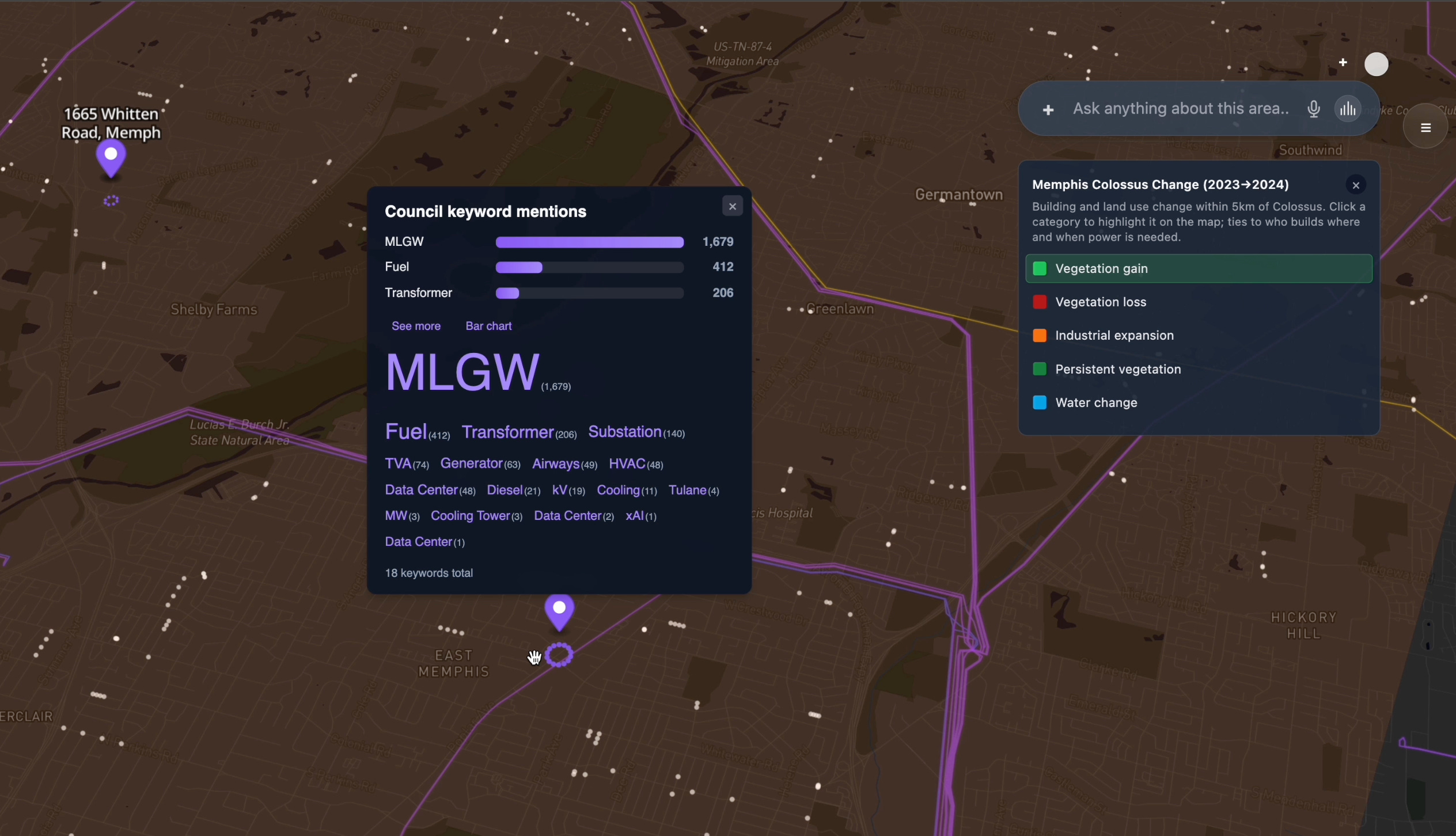
The permit layer catches what the announcements miss. The substation timing tells you when power actually arrives, not when it’s promised. The satellite change detection shows what’s moving on the ground before anything gets filed. The council signals track where the opposition forms before it makes the news. Pre-queue intelligence across Tennessee, Mississippi, and Arkansas as a single regional cluster.
Behind the map, a new architecture is coming together — automated watchers pulling from public utility filings, permit databases, and interconnection queues daily. A linker that connects raw signals to specific assets with a confidence score. A canonical schema that makes every market speak the same language. The goal is a system that sees what’s coming before it’s announced, across every market I cover.
To the first 100 people who explored the Texas map last week — thank you. You showed me what serious practitioners actually do with this kind of data. That’s what this research is built on.
More to come.
— Yair
Infrastructure Research publishes weekly. If someone forwarded this — subscribe here.